


Texas Public Opinion Research (TPOR)—a nonpartisan polling initiative dedicated to exploring Texans’ beliefs and priorities—today released a new poll of Texas likely general election voters, focused on the 2026 statewide races, including the contests for U.S. Senate, Governor, Attorney General, Lieutenant Governor, Comptroller, Agriculture Commissioner, Land Commissioner, and Railroad Commissioner.
This is the second release in a series of monthly tracking polls that TPOR will release through the November 3 election.
The poll finds Democrat James Talarico (49%) leading Republican Ken Paxton (44%) by five points in the U.S. Senate race. Meanwhile, Republican Greg Abbott (50%) leads Democrat Gina Hinojosa (46%) by four points in the Governor’s race. In the Attorney General’s race, Republican Mayes Middleton leads Democrat Nathan Johnson by three points (46% to 43%). Notably, the race for Texas Railroad Commissioner has narrowed, with Republican Bo French leading Democrat Jon Rosenthal by just one point, 45% to 44%.
Note: For this tracking poll series, topline results include leaners.
The survey of 1,007 likely Texas voters was conducted from September 19 to September 22, 2026 and has a margin of error of ±3.6 percentage points. The full topline is available here, and crosstabs are available upon request.
U.S. Senate Race
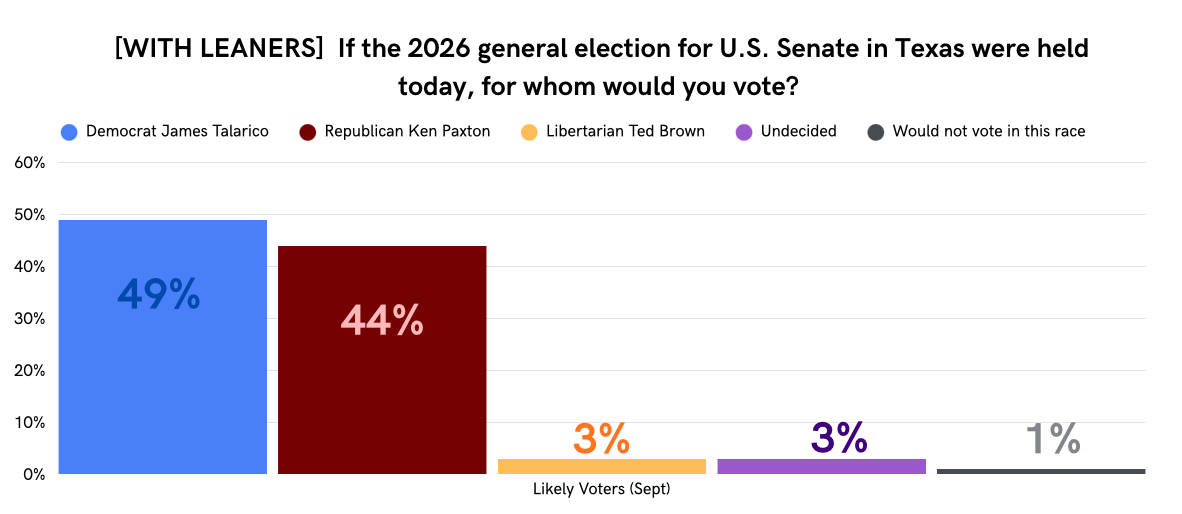
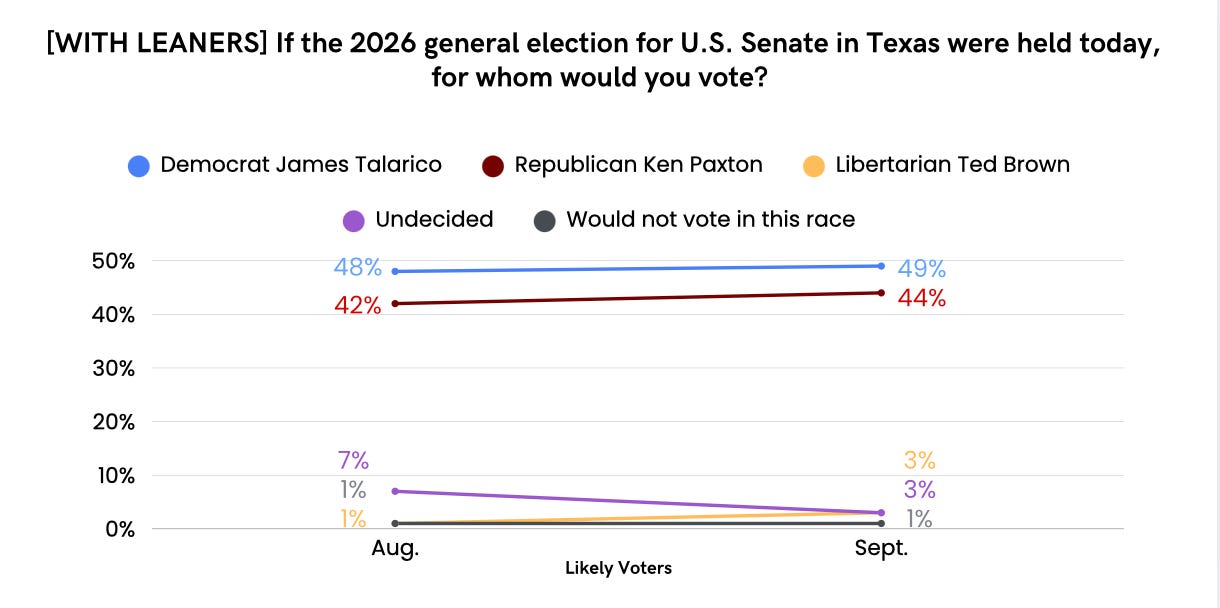
Democrat James Talarico (49%) leads Republican Ken Paxton (44%) by five points in the U.S. Senate race, with 3% of voters still undecided. Libertarian Ted Brown receives 3% of the vote. Compared to our August poll, Talarico’s lead over Paxton narrowed by one point (net +6 to +5). The share of undecided voters decreased from 7% to 3% while support for Brown increased by two points, from 1% to 3%.
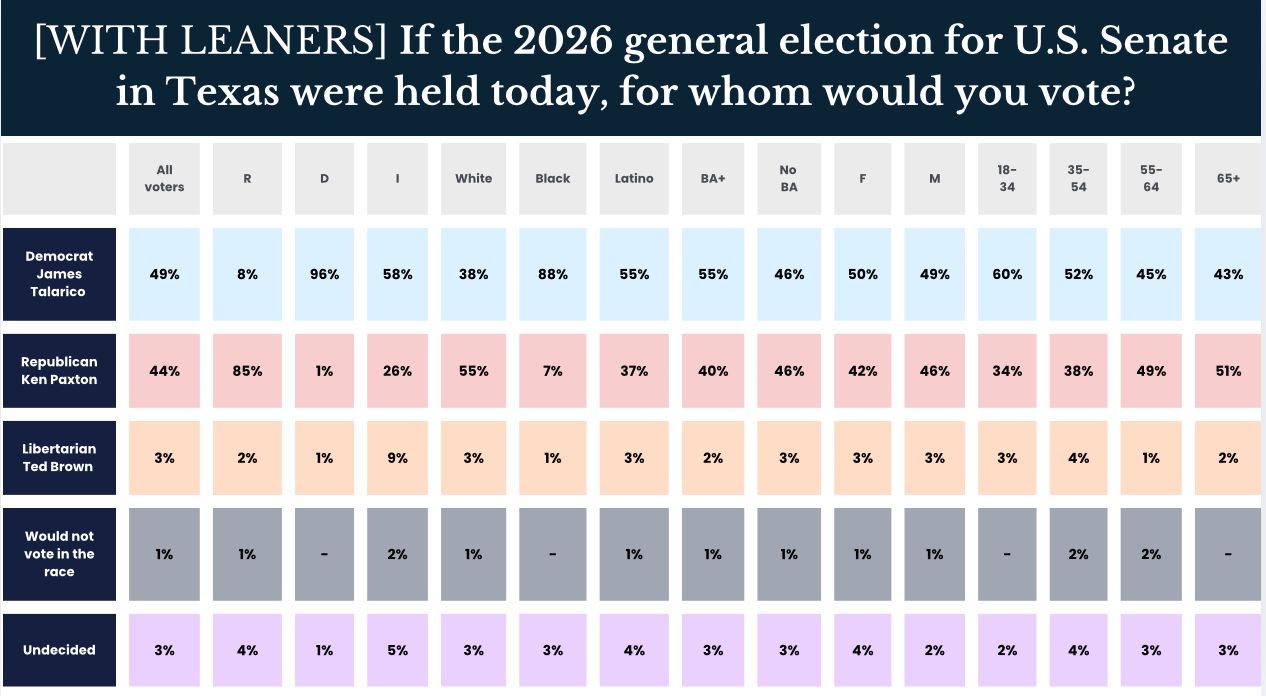
Among independents, Talarico leads by 32 points (58% to 26%), with 5% undecided. Paxton leads with white voters and voters ages 55 and older, while Talarico leads with Black voters, Latino voters, voters under 55, college-educated voters, and both men and women.
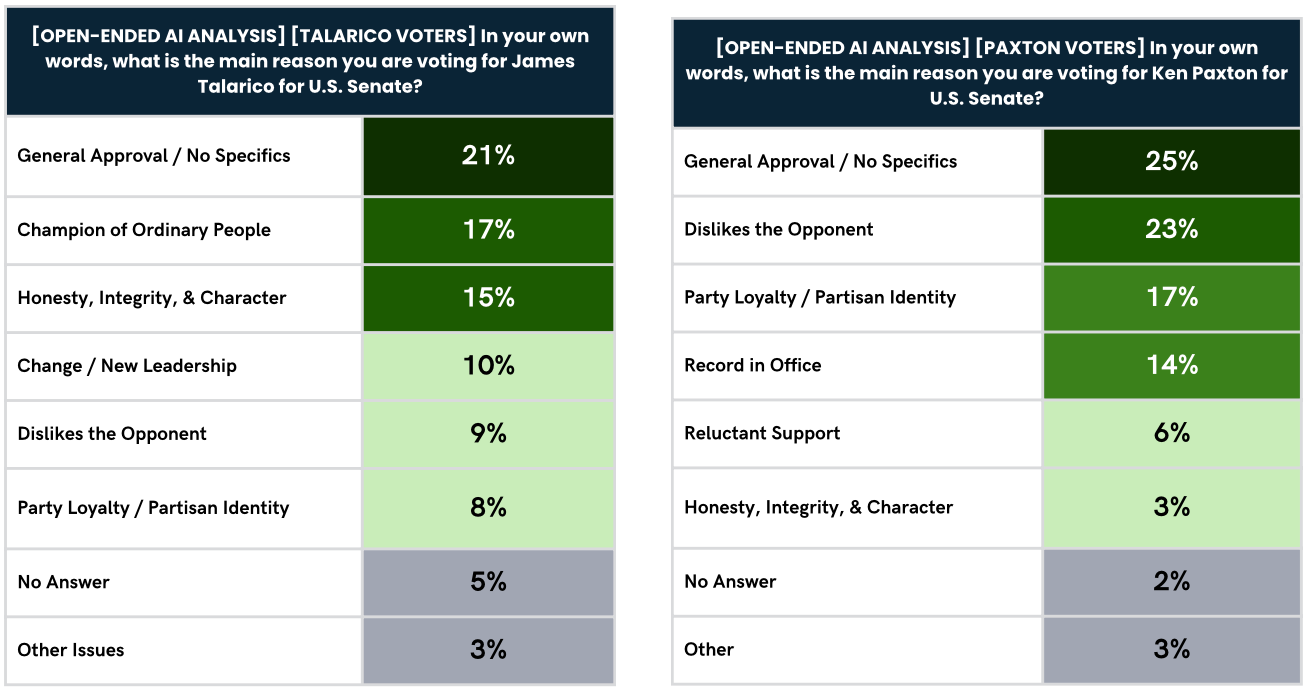
In an open-ended question, Talarico voters most commonly cite general approval (21%) as the main reason for their support for him, followed by seeing him as a champion of ordinary people (17%), his honesty, integrity, and character (15%), and a desire for change and new leadership (10%). Among Paxton voters, general approval (25%) is the top reason for supporting him, followed closely by dislike of Talarico (23%), party loyalty (17%), and his record in office (14%).
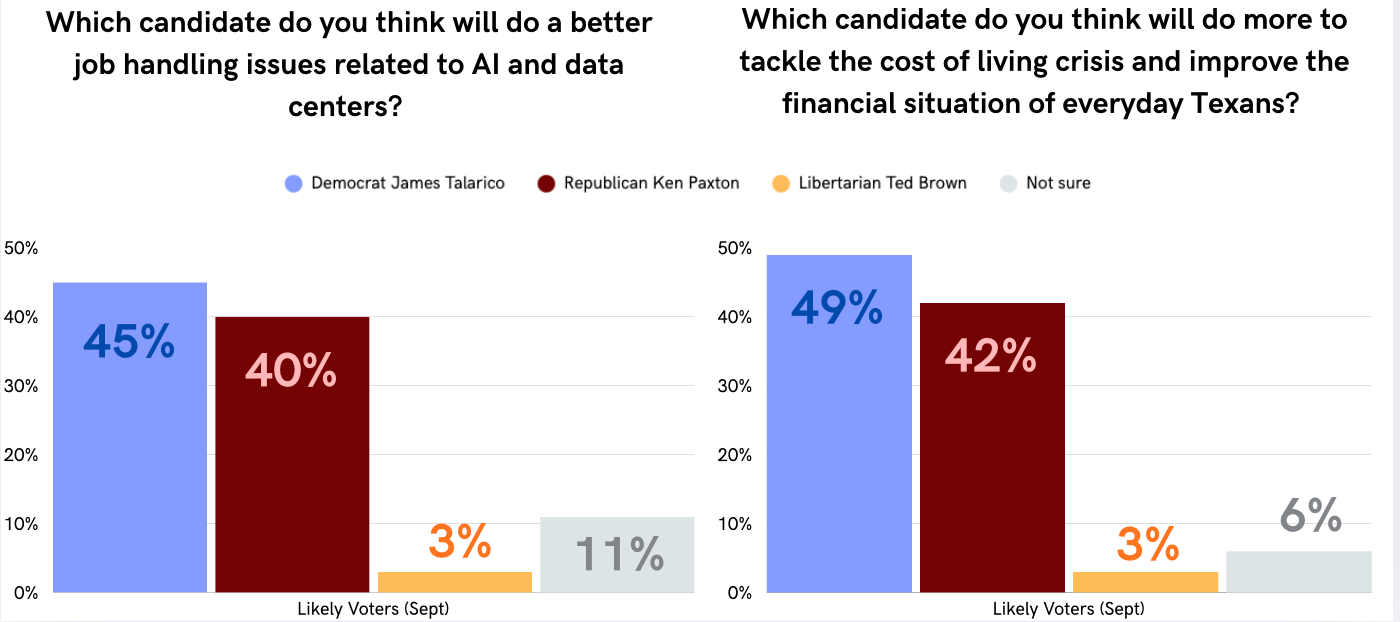
When asked which of the Senate candidates they think will do more to tackle the cost-of-living crisis and improve the financial situation of everyday Texans, 49% of voters say Talarico, 42% say Paxton, and 6% are not sure. When asked which of the Senate candidates they think will do a better job handling issues related to AI and data centers, a plurality of voters (45%) say Talarico, 40% say Paxton, and 11% are not sure.
Gubernatorial Race
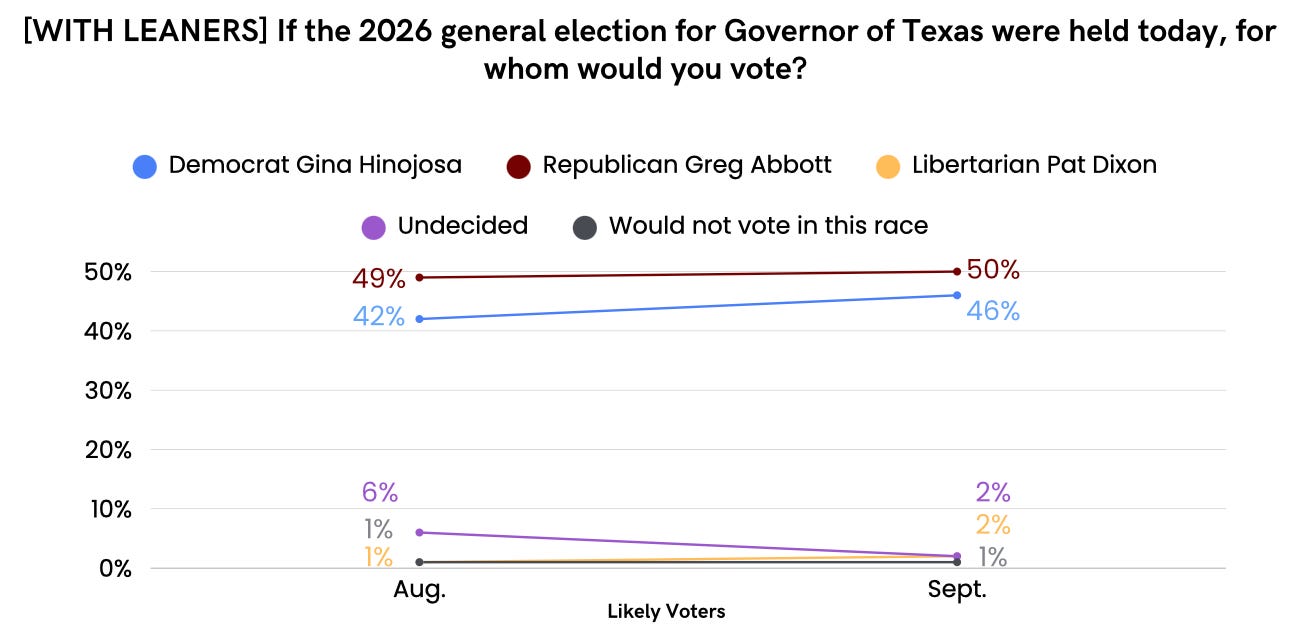
Republican Greg Abbott (50%) leads Democrat Gina Hinojosa (46%) by four points in the Governor’s race, with 2% of voters still undecided and Libertarian Pat Dixon receiving 2% of the vote. Compared to our August poll, Abbott’s lead over Hinojosa narrowed by three points, from +7 to +4. The share of undecided voters dropped from 6% to 2%, while support for Libertarian Pat Dixon rose one point, from 1% to 2%
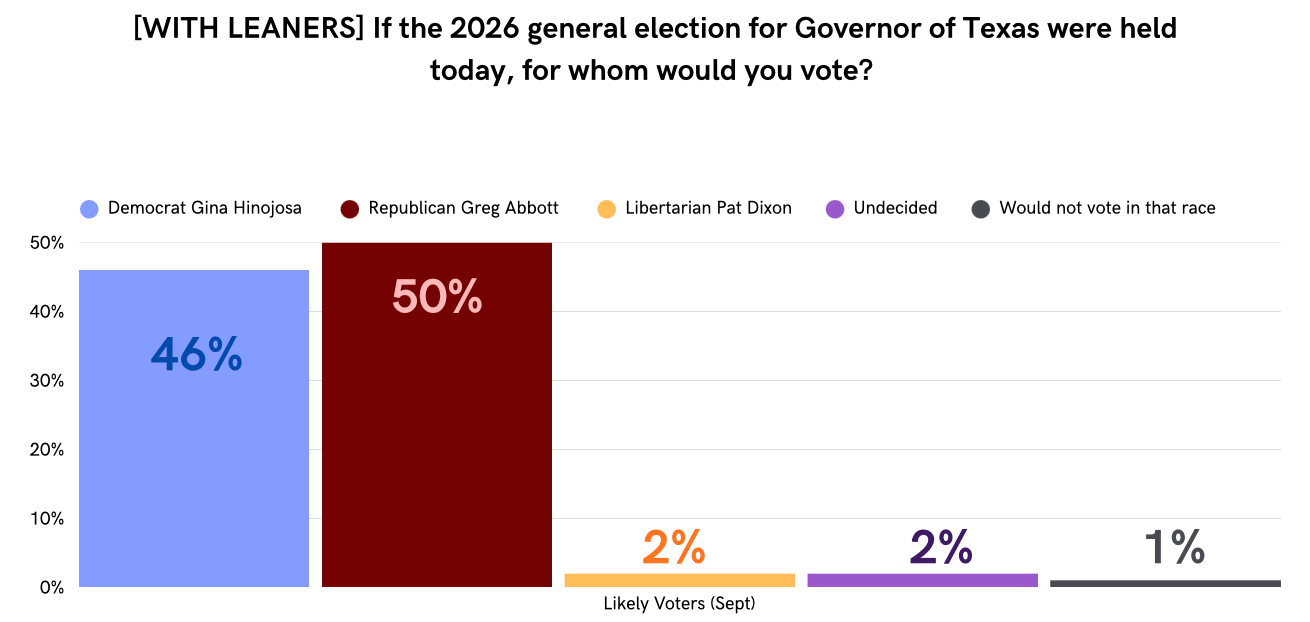
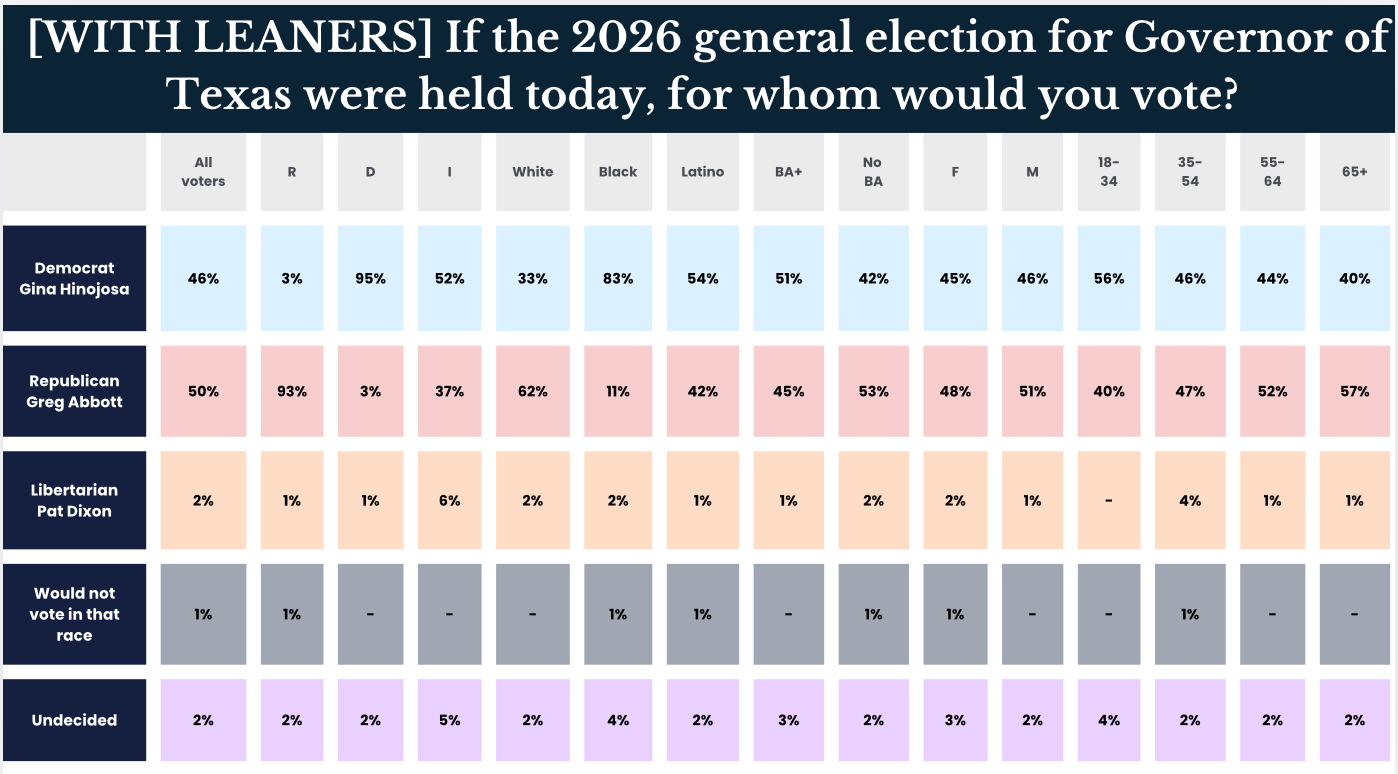
Among independents, Hinojosa leads by 15 points (52% to 37%), with 5% undecided. Abbott leads with white voters, voters without a college degree, men, women, and voters ages 55 and older. Hinojosa leads with Black voters, Latino voters, voters ages 18 to 34, and college-educated voters.
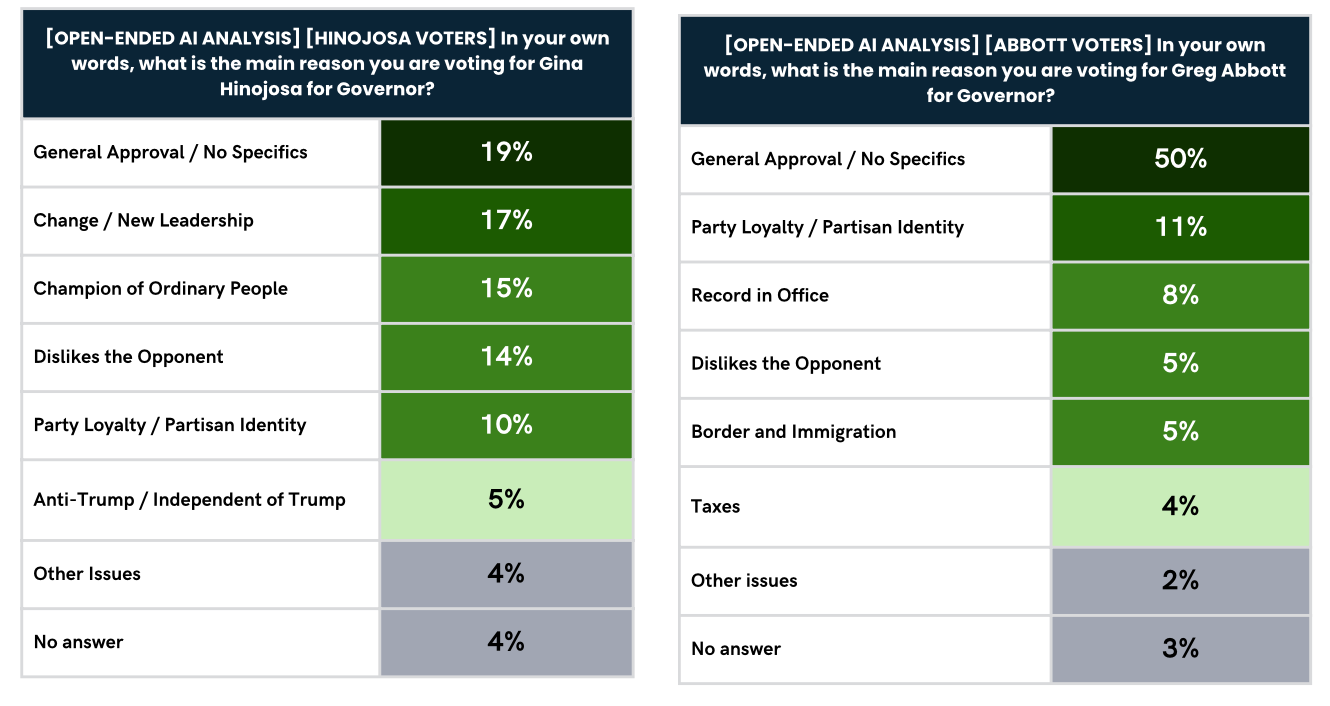
In an open-ended question, Hinojosa voters most commonly cite general approval (19%) as the main reason for their support for her, followed by a desire for change and new leadership (17%), seeing her as a champion of ordinary people (15%), and dislike of Abbott (14%). Among Abbott voters, half (50%) cite general approval, followed by party loyalty (11%), his record in office (8%), and the border and immigration and dislike of Hinojosa and (5% each).
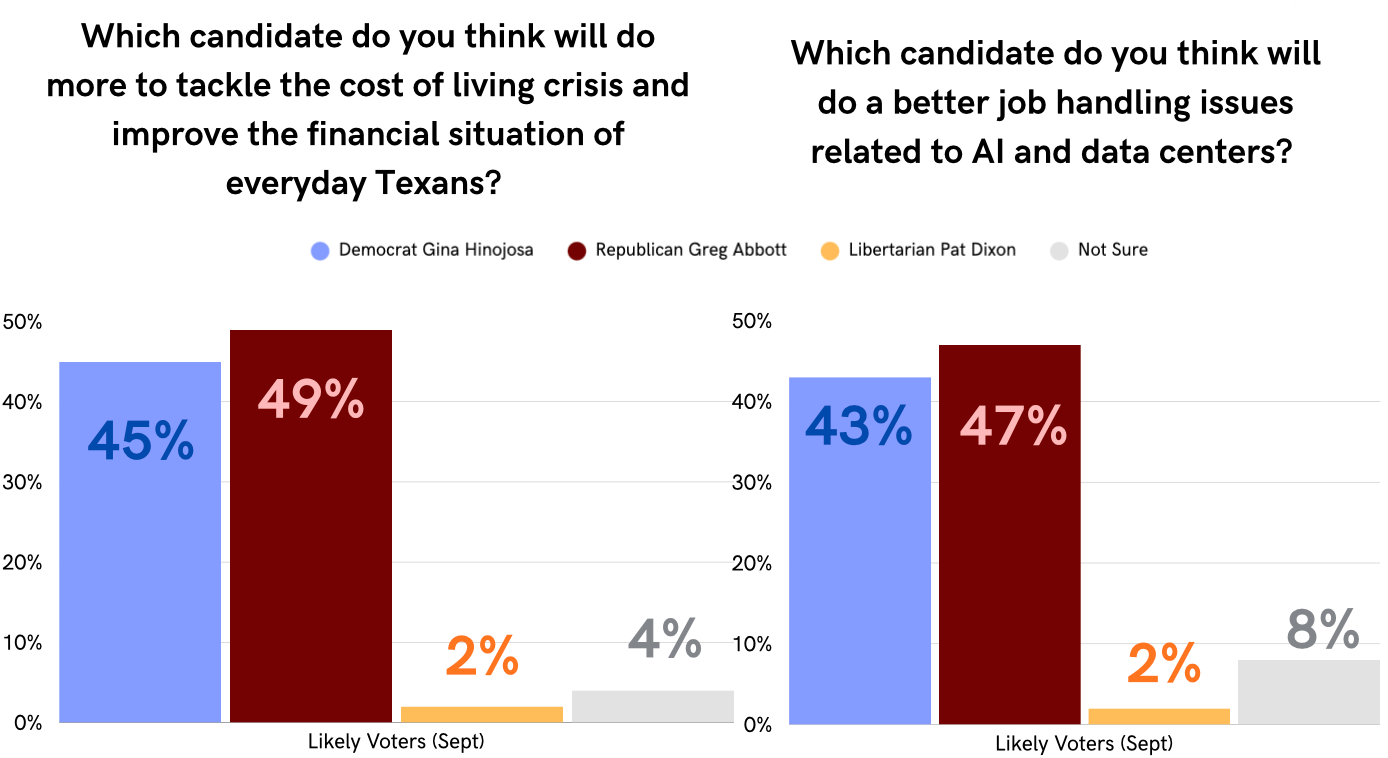
When asked which gubernatorial candidate will do more to tackle the cost-of-living crisis and improve the financial situation of everyday Texans, 49% of voters say Abbott, 45% say Hinojosa, 2% say Dixon, and 4% are not sure. On handling issues related to AI and data centers, 47% say Abbott, 43% say Hinojosa, 2% say Dixon, and 8% are not sure.
Ticket Splitters
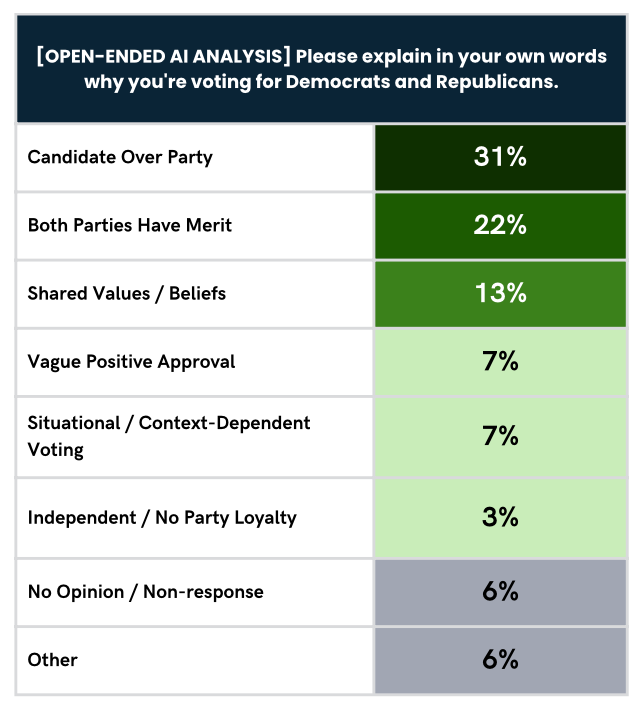
In an open-ended question, when asked why they are voting for candidates from both parties, ticket splitters most often say that they are driven by candidate quality rather than party affiliation (31%), followed by the belief that both parties have merit (22%) and shared values or beliefs (13%).
Job Approval
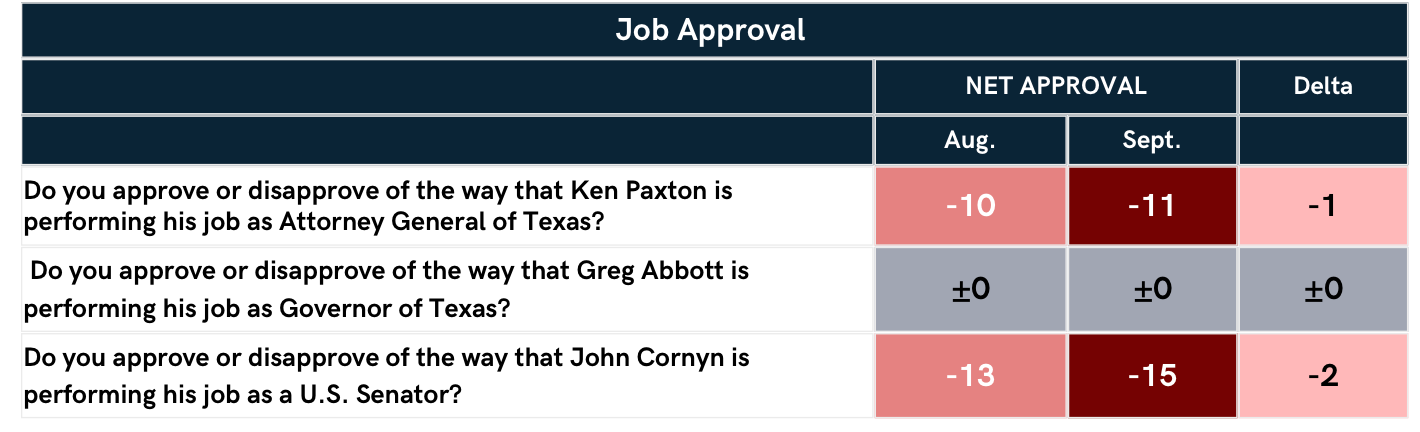
Abbott has a net job approval rating of ±0, with equal shares of voters (49% each) approving and disapproving of the way he is performing his job as Governor. Forty-two percent of voters approve of the way Paxton is performing his job as attorney general, while 53% disapprove, giving him a net job approval rating of -11. Senator John Cornyn has a net approval rating of -15 (36% approve, 51% disapprove). Over the last month, net approval for both Cornyn and Paxton have decreased while Abbott’s remained stable at ±0.
Favorability
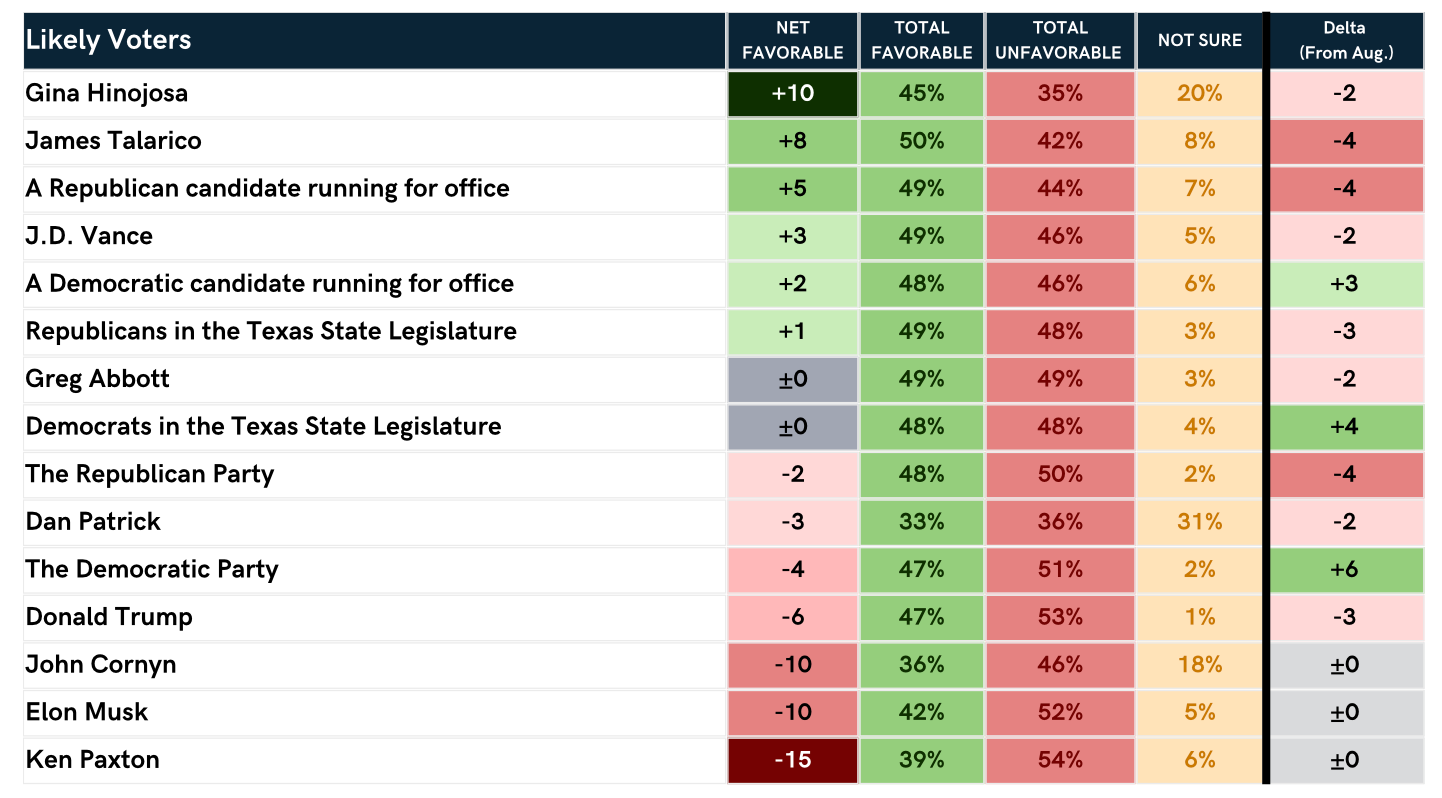
Gina Hinojosa receives the highest net favorability rating of all figures and groups tested (+10), followed by James Talarico (+8), with more voters being unfamiliar with Hinojosa 20% than with Talarico (8%). Over the past month, Hinojosa and Talarico’s net favorability decreased, while favorability for a generic Democrat and the Democratic Party increased. Greg Abbott registers a ±0 net favorability rating, decreasing two points from last month. Donald Trump (-6), John Cornyn (-10), Elon Musk (-10), and Ken Paxton (-15) rounded out the bottom half of the favorability scale. Trump’s favorability decreased by three points while Cornyn, Musk, and Paxton remained stable.
Attorney General Race
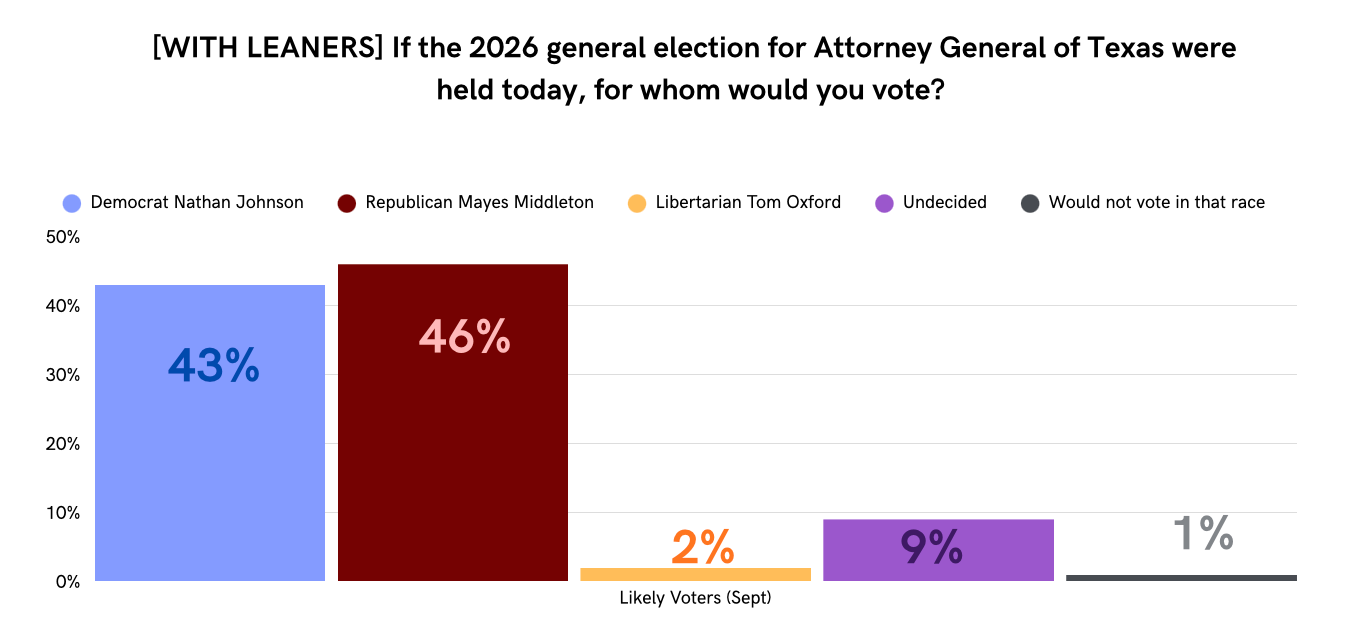
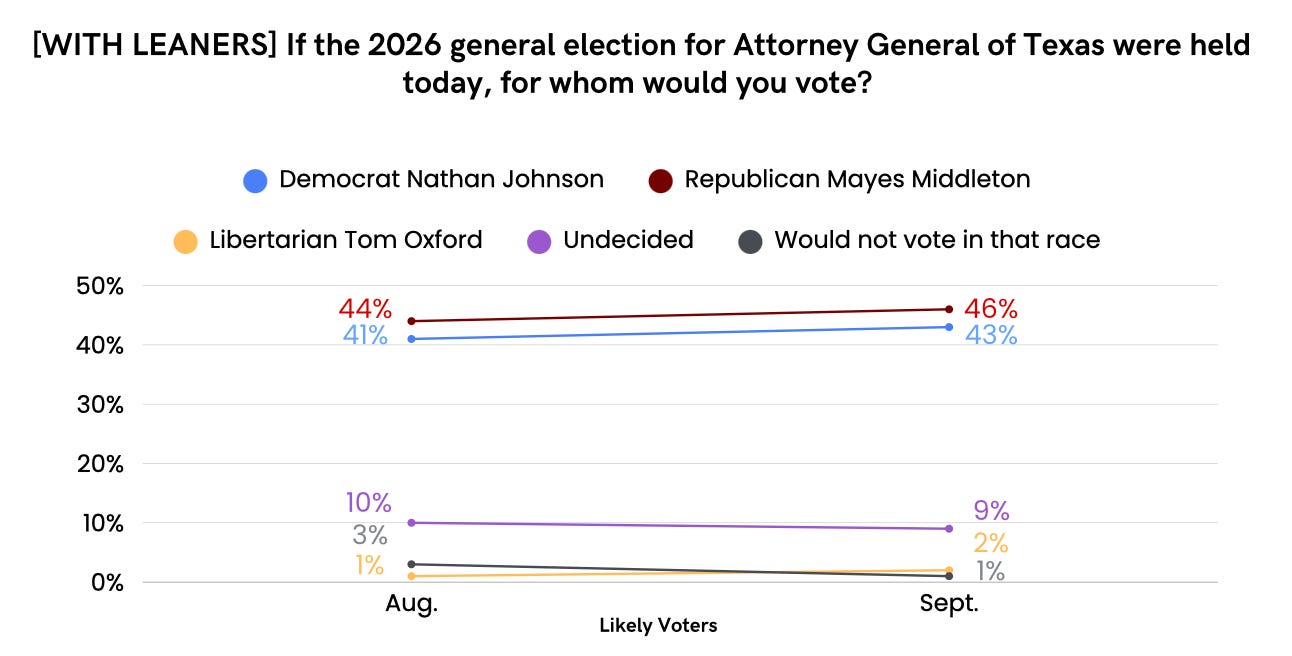
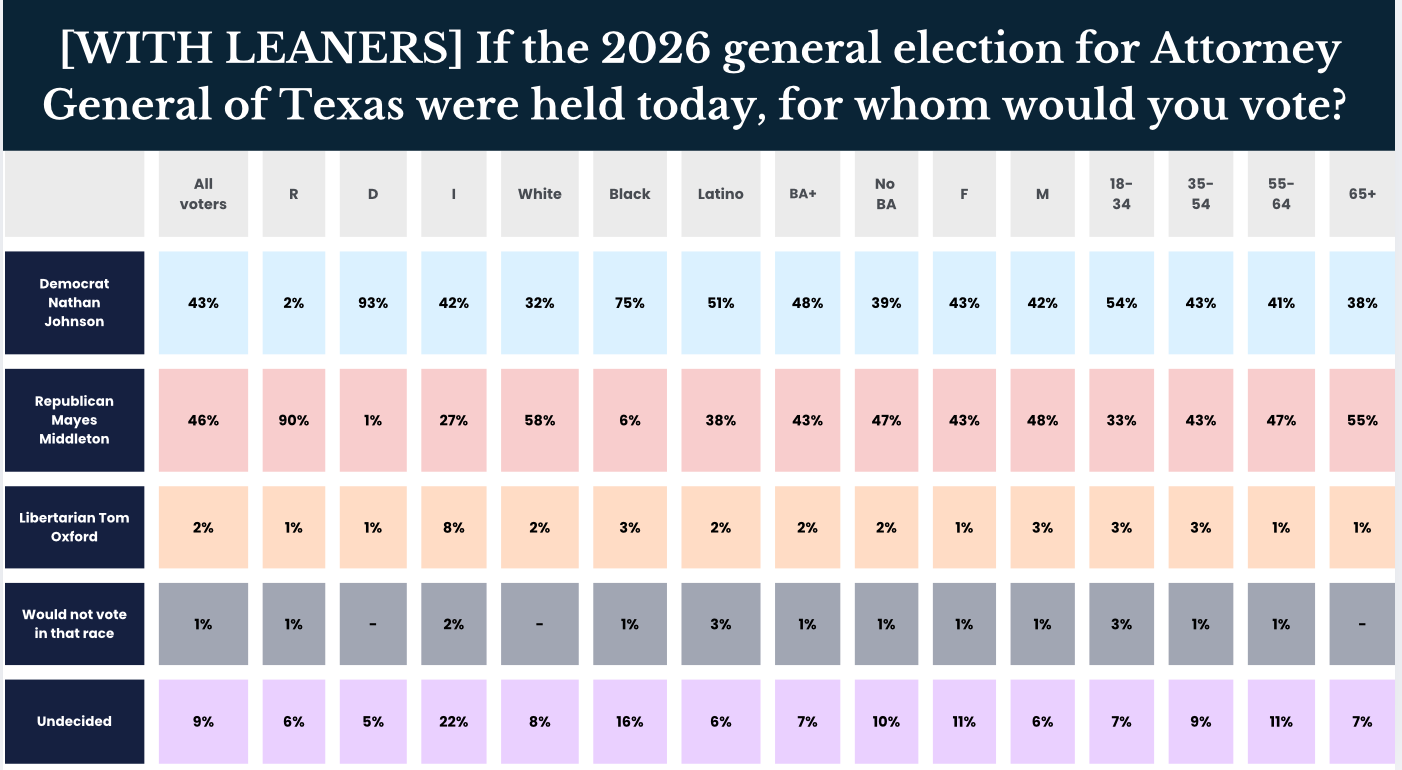
Republican Mayes Middleton (46%) leads Democrat Nathan Johnson (43%) by three points in the Attorney General’s race, with 9% of voters still undecided and Libertarian Tom Oxford receiving 2% of the vote. Compared to our August poll, the margin is unchanged, with both candidates gaining two points. The share of undecided voters drops from 10% to 9%, while support for Oxford rises from 1% to 2%.
Lieutenant Governor’s Race
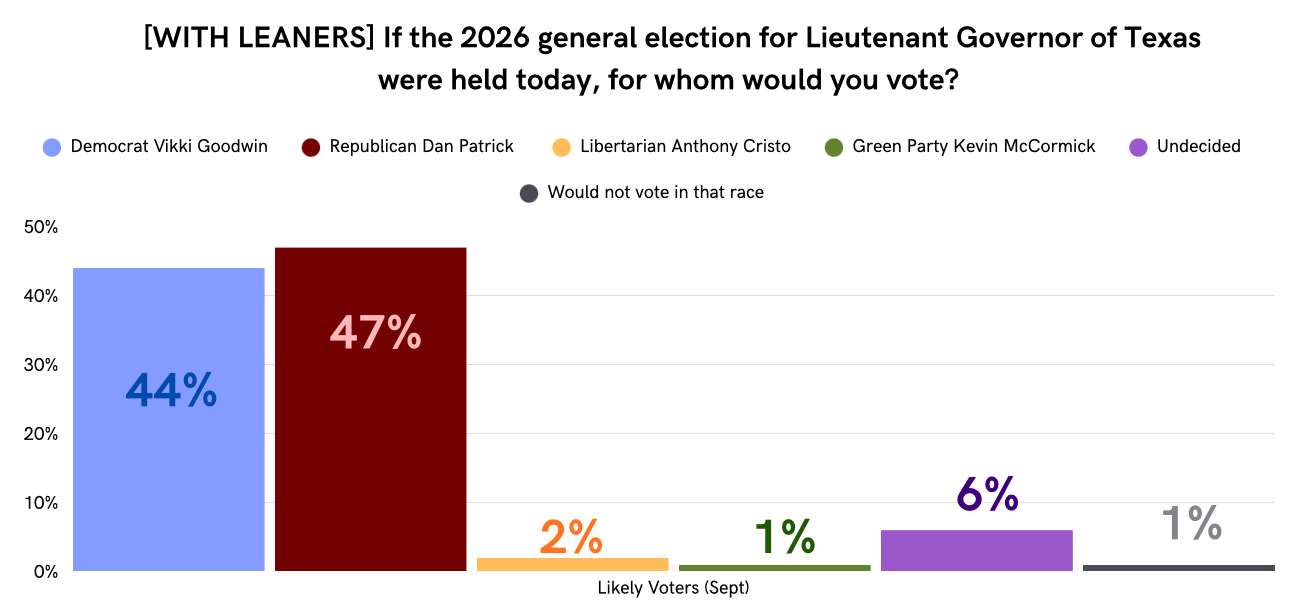
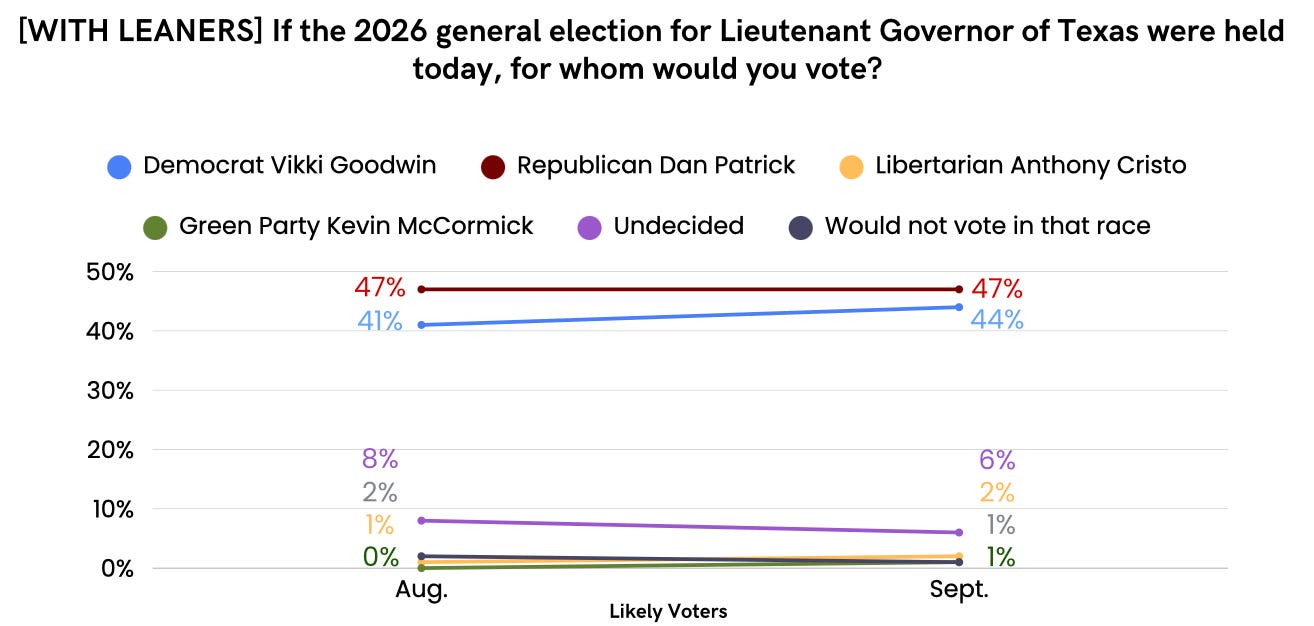
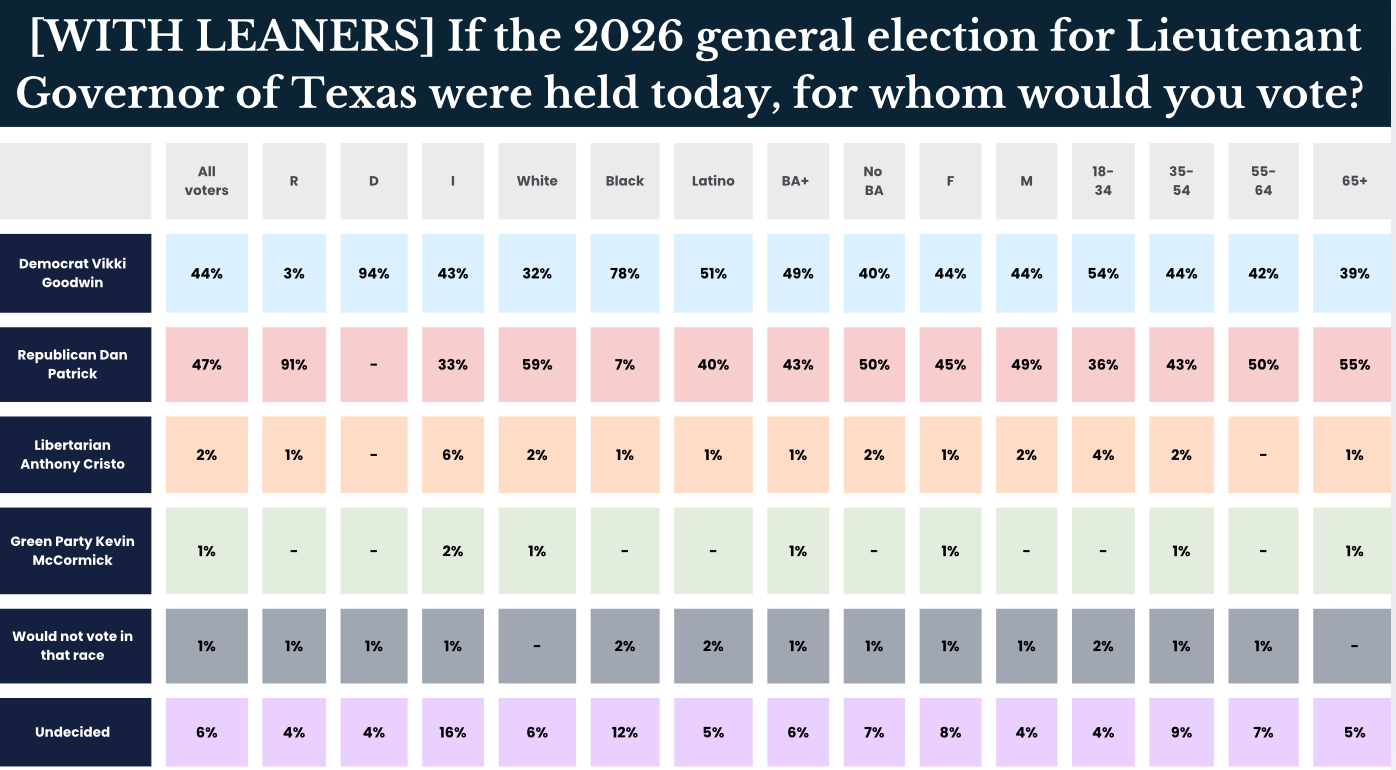
Republican Dan Patrick (47%) leads Democrat Vikki Goodwin (44%) by three points in the Lieutenant Governor’s race, with 6% of voters still undecided. Libertarian Anthony Cristo receives 2% of the vote and Green Party candidate Kevin McCormick receives 1%. Compared to our August poll, Patrick’s lead narrows from six points to three, driven entirely by Goodwin’s three-point gain. The share of undecided voters drops from 8% to 6%, while support for Cristo and McCormick each rises one point.
Comptroller Race
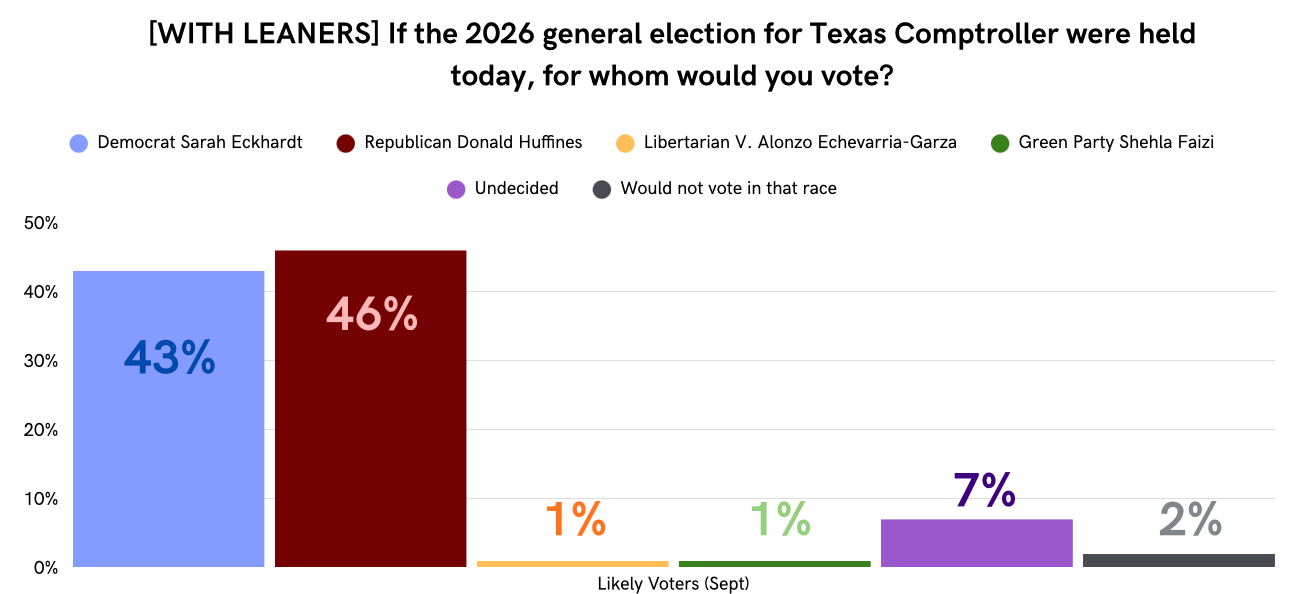
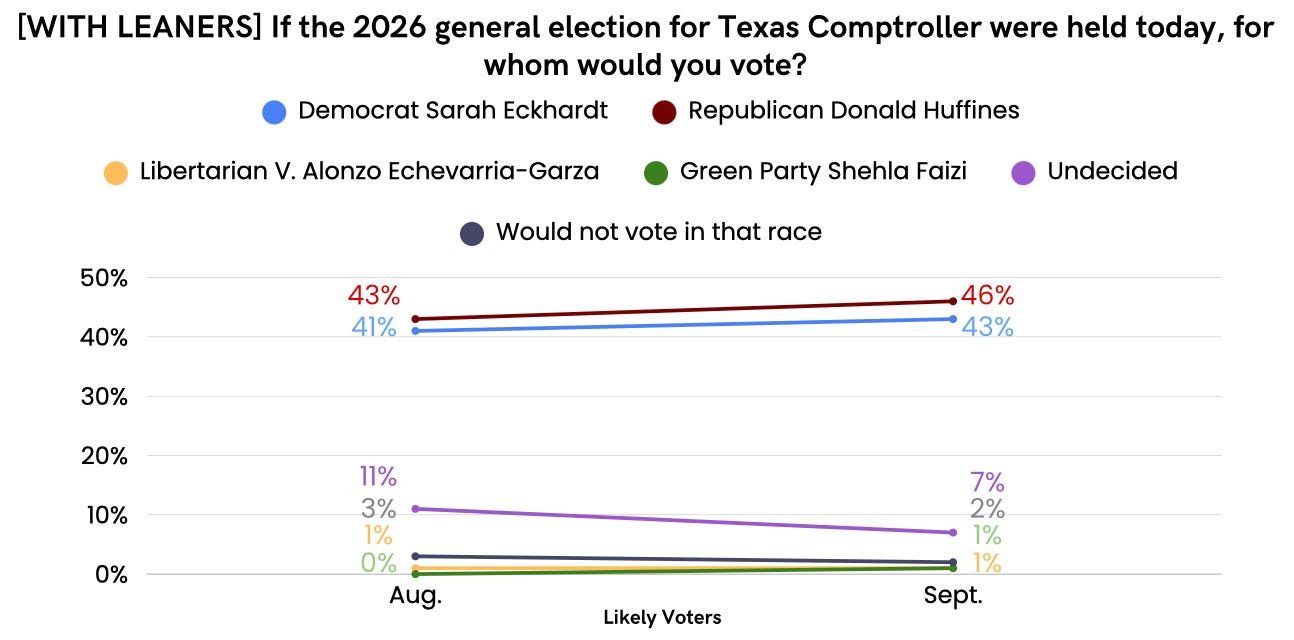
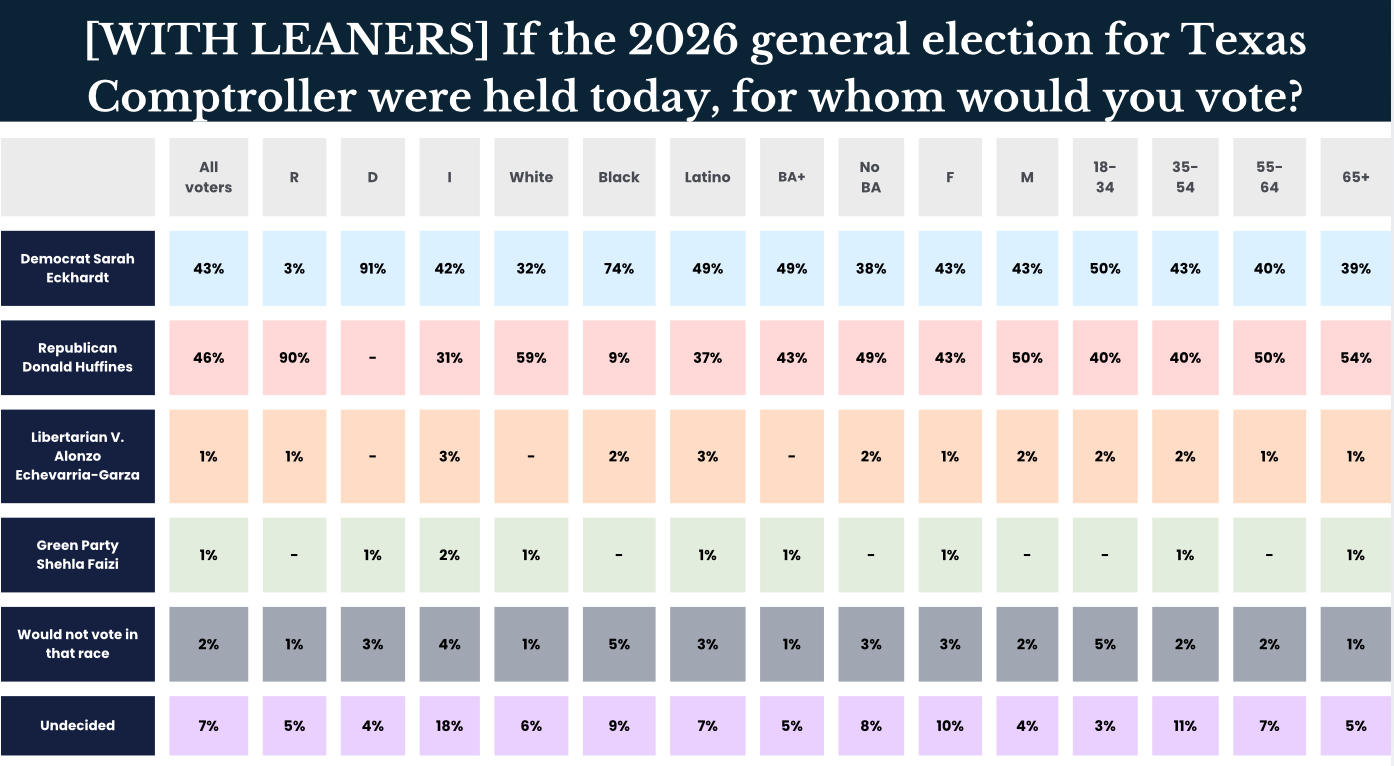
Republican Donald Huffines (46%) leads Democrat Sarah Eckhardt (43%) by three points in the Comptroller’s race, with 7% of voters still undecided. Libertarian V. Alonzo Echevarria-Garza and Green Party candidate Shehla Faizi each receive 1% of the vote. Compared to our August poll, Huffines’ lead grows by one point, from two to three, as he gains three points to Eckhardt’s two. The share of undecided voters drops from 11% to 7%, support for Faizi rises one point, and support for Echevarria-Garza holds steady at 1%.
Agriculture Commissioner Race
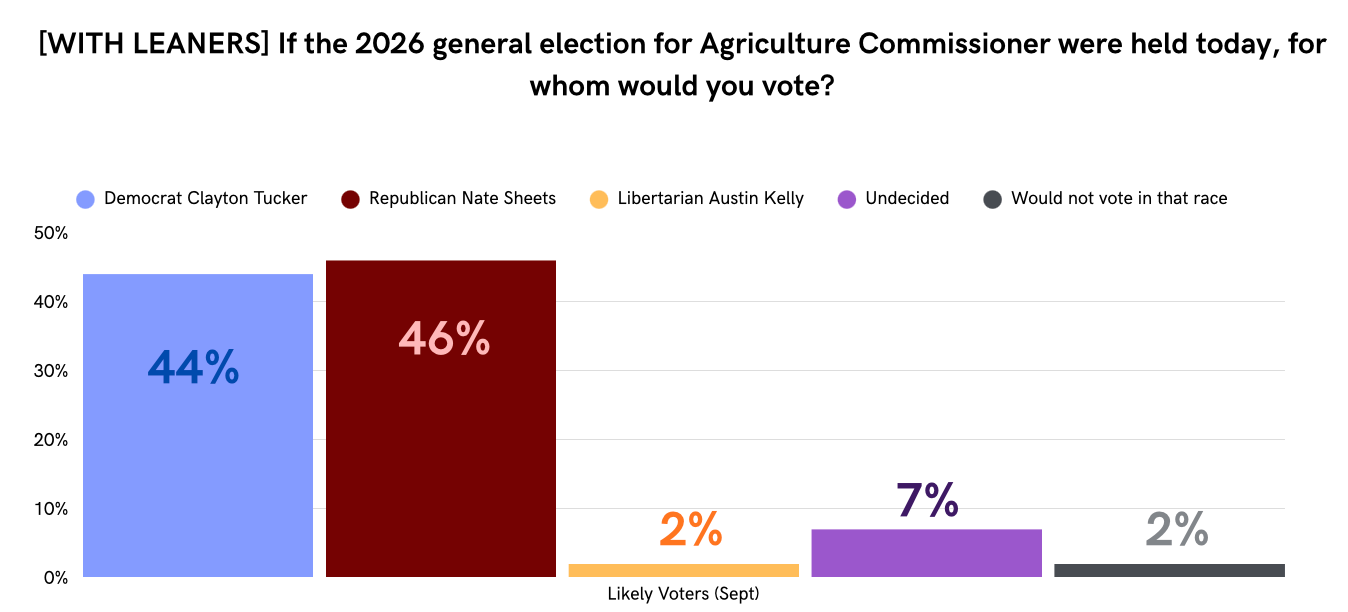
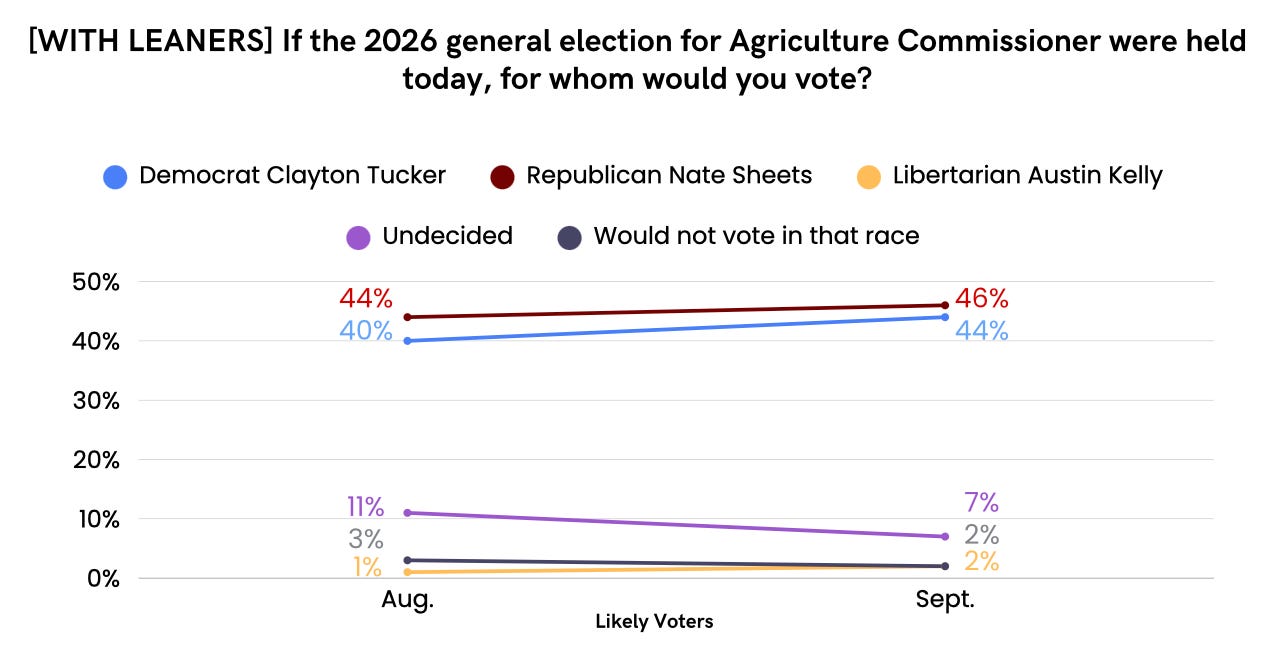
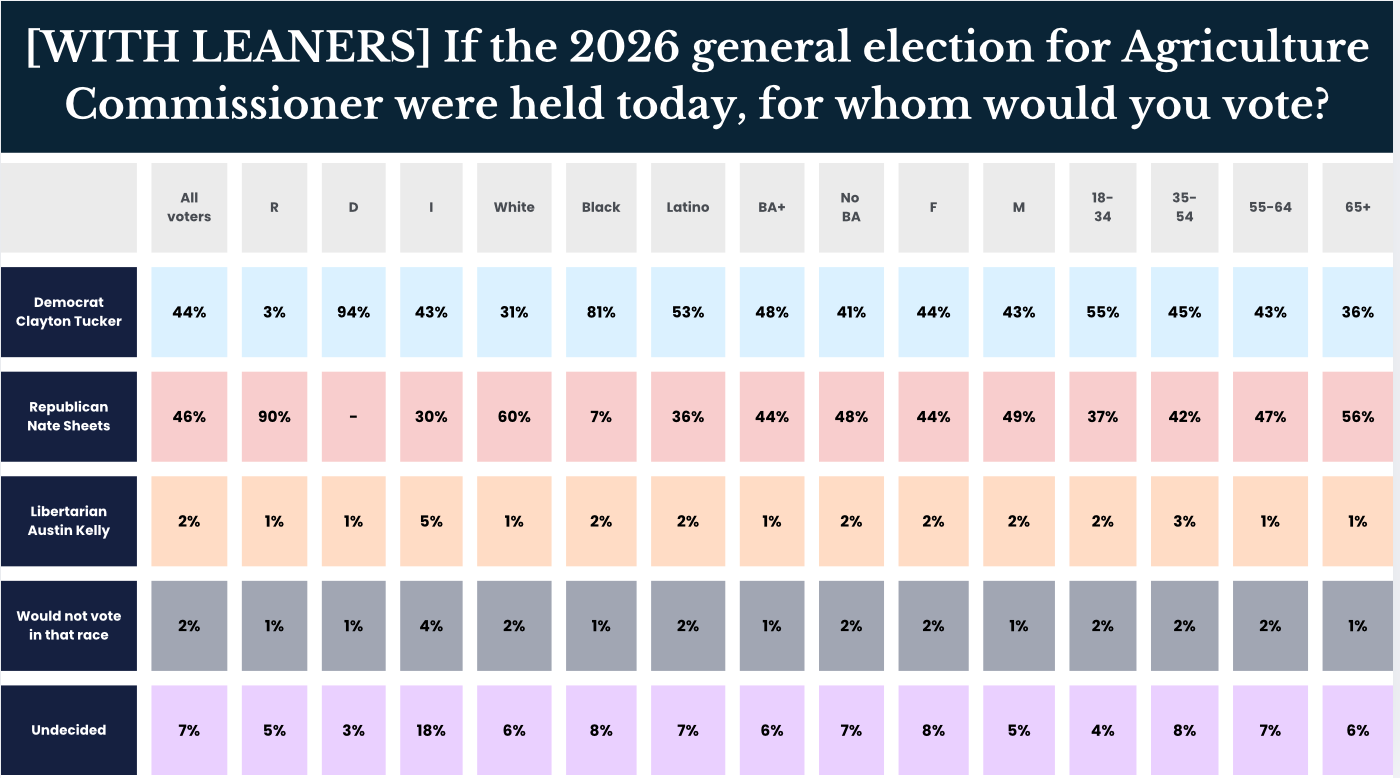
Republican Nate Sheets (46%) leads Democrat Clayton Tucker (44%) by two points in the Agriculture Commissioner’s race, with 7% of voters still undecided and Libertarian Austin Kelly receiving 2% of the vote. Compared to our August poll, Sheets’ lead narrows from four points to two, as Tucker gains four points to Sheets’ two. The share of undecided voters drops from 11% to 7%, while support for Kelly rises from 1% to 2%.
Land Commissioner Race
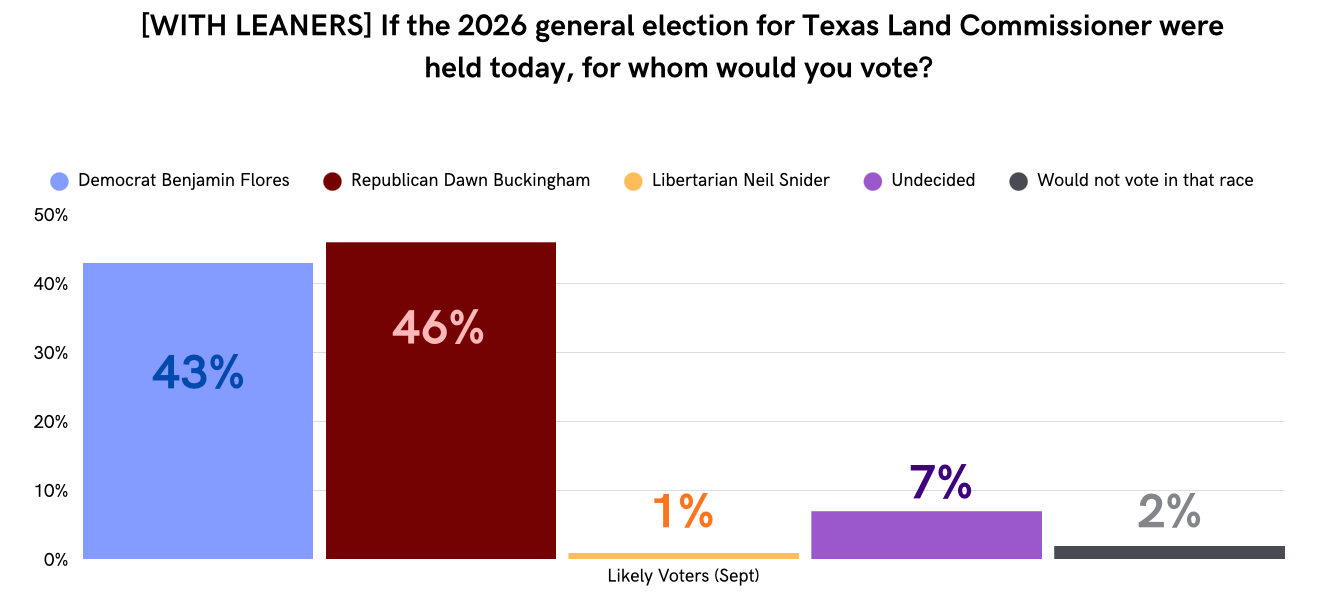
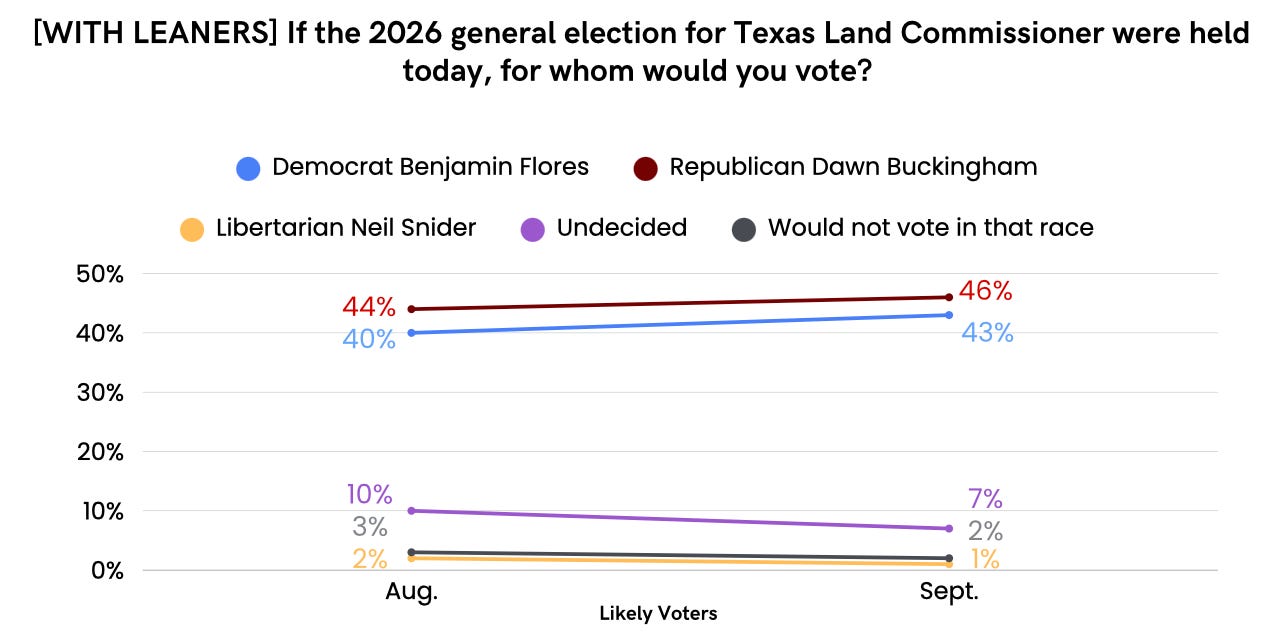
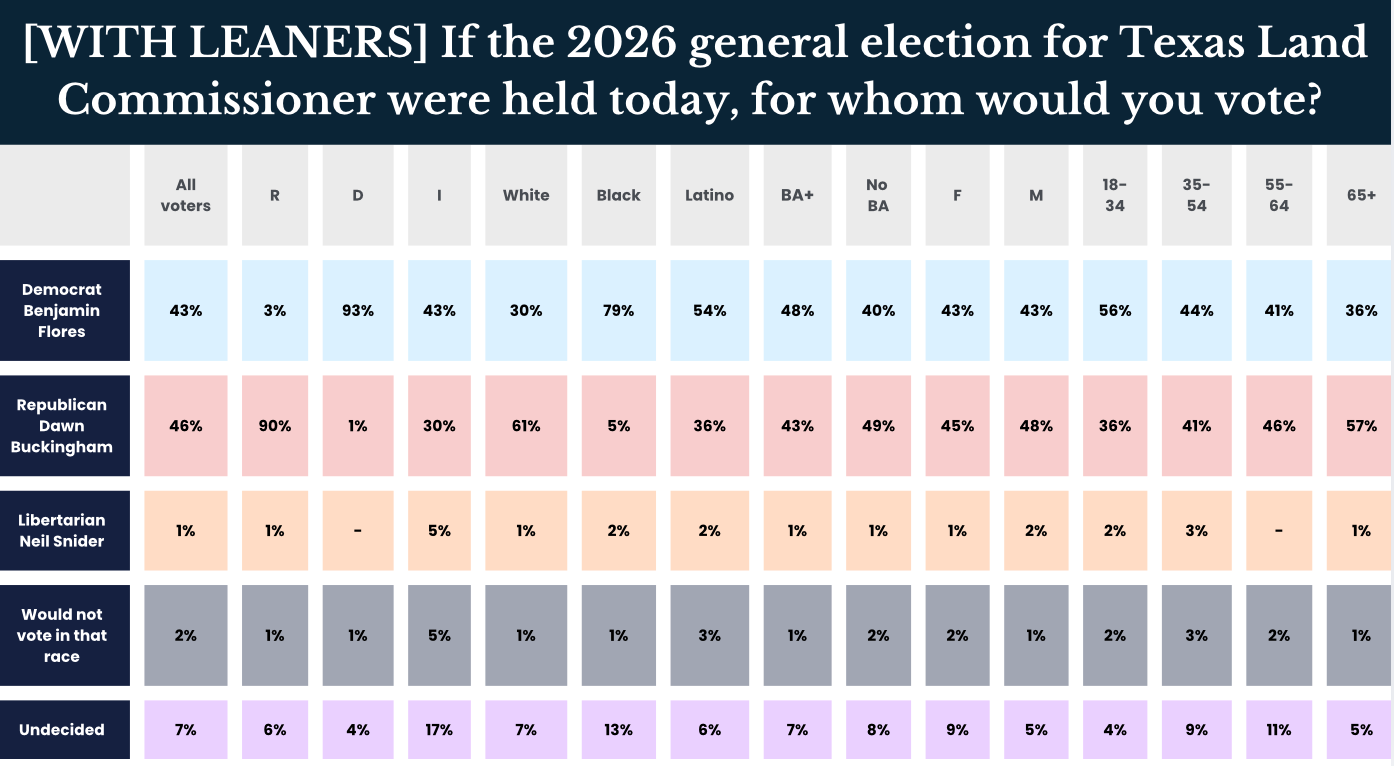
Republican Dawn Buckingham (46%) leads Democrat Benjamin Flores (43%) by three points in the Land Commissioner’s race, with 7% of voters still undecided and Libertarian Neil Snider receiving 1% of the vote. Compared to our August poll, Buckingham’s lead narrows from four points to three, as Flores gains three points to Buckingham’s two. The share of undecided voters drops from 10% to 7%, while support for Snider slips from 2% to 1%.
Railroad Commissioner Race
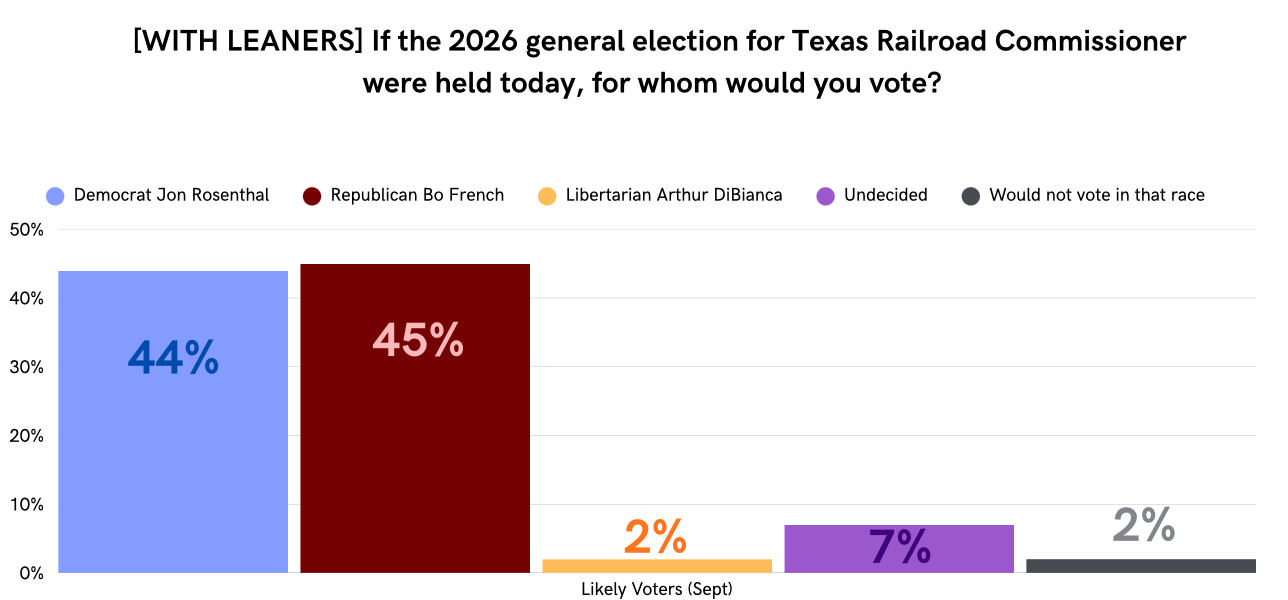
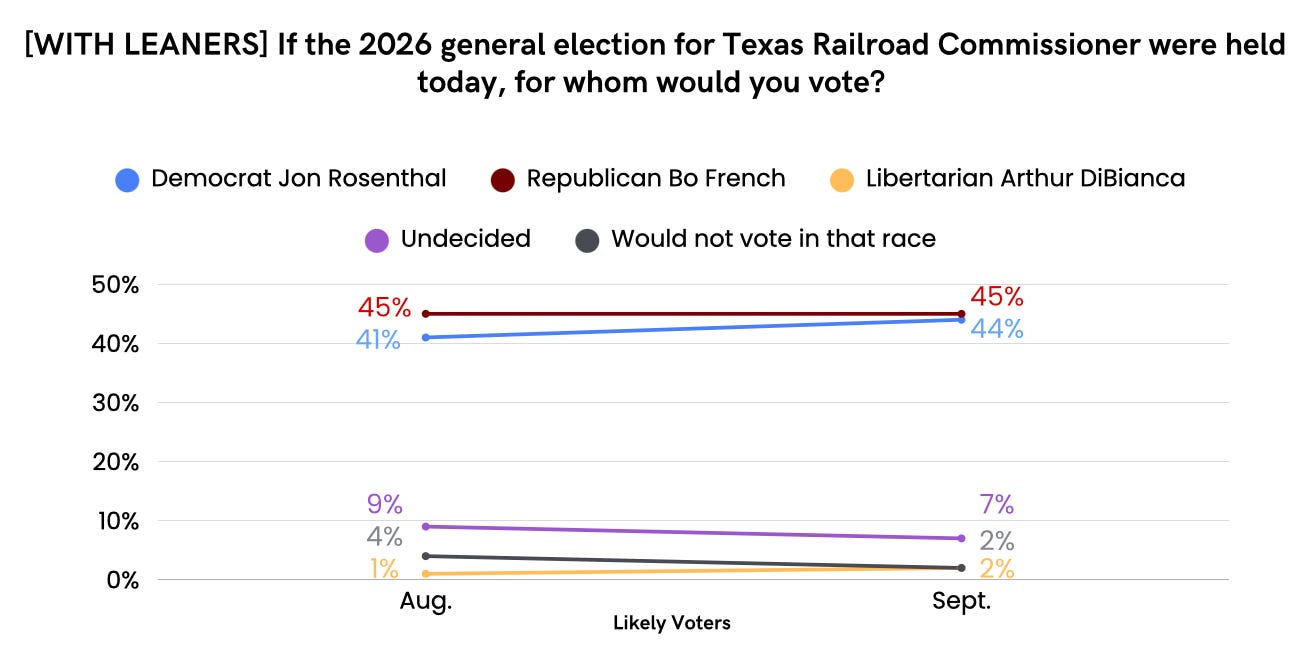
Republican Bo French (45%) leads Democrat Jon Rosenthal (44%) by one point in the Railroad Commissioner’s race, with 7% of voters still undecided and Libertarian Arthur DiBianca receiving 2% of the vote. Compared to our August poll, French’s lead narrows from four points to one, driven entirely by Rosenthal’s three-point gain. The share of undecided voters drops from 9% to 7%, while support for DiBianca rises from 1% to 2%.
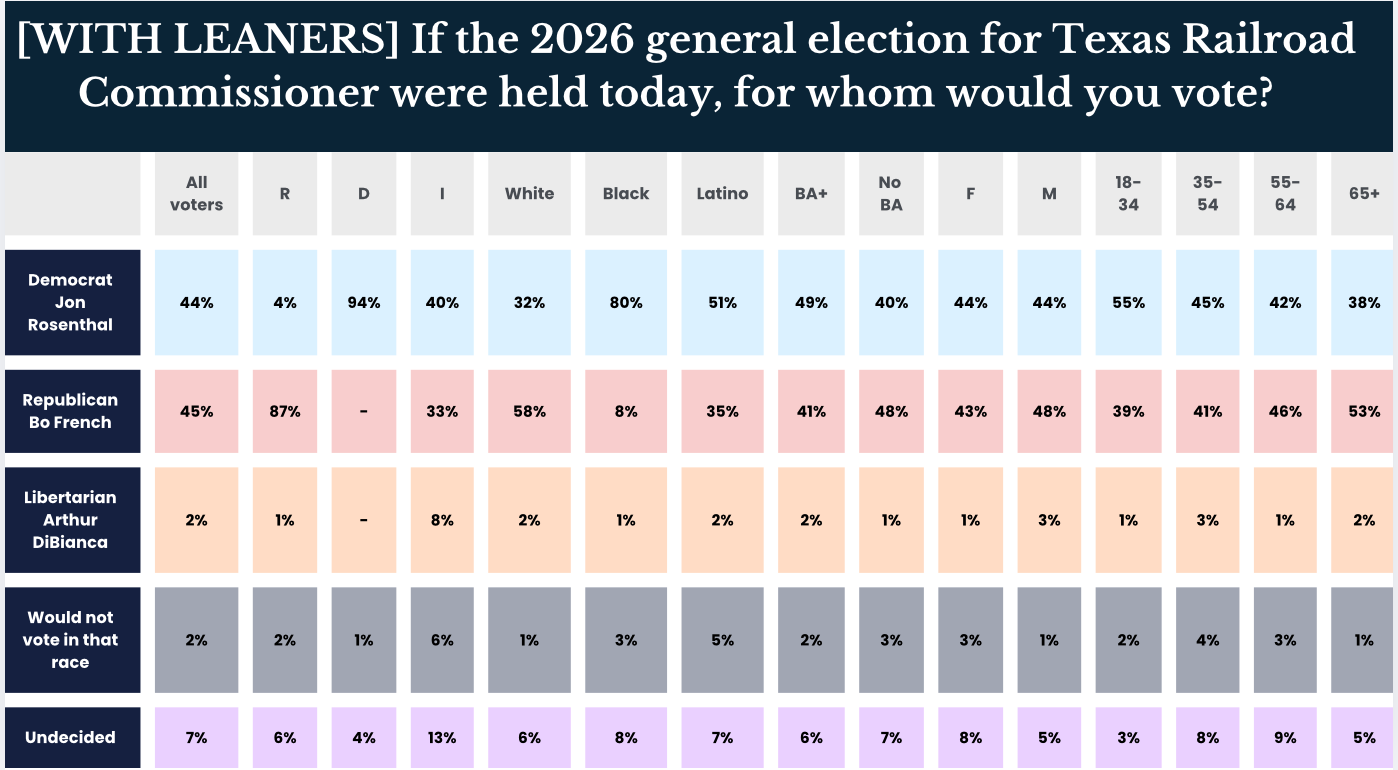
Among independents, Rosenthal leads by a 7-point margin (40% to 33%), with 13% undecided. French leads with white voters, voters without a college degree, men, and voters ages 55 and older. Rosenthal leads with Black voters, Latino voters, college-educated voters, voters under 55, and women.
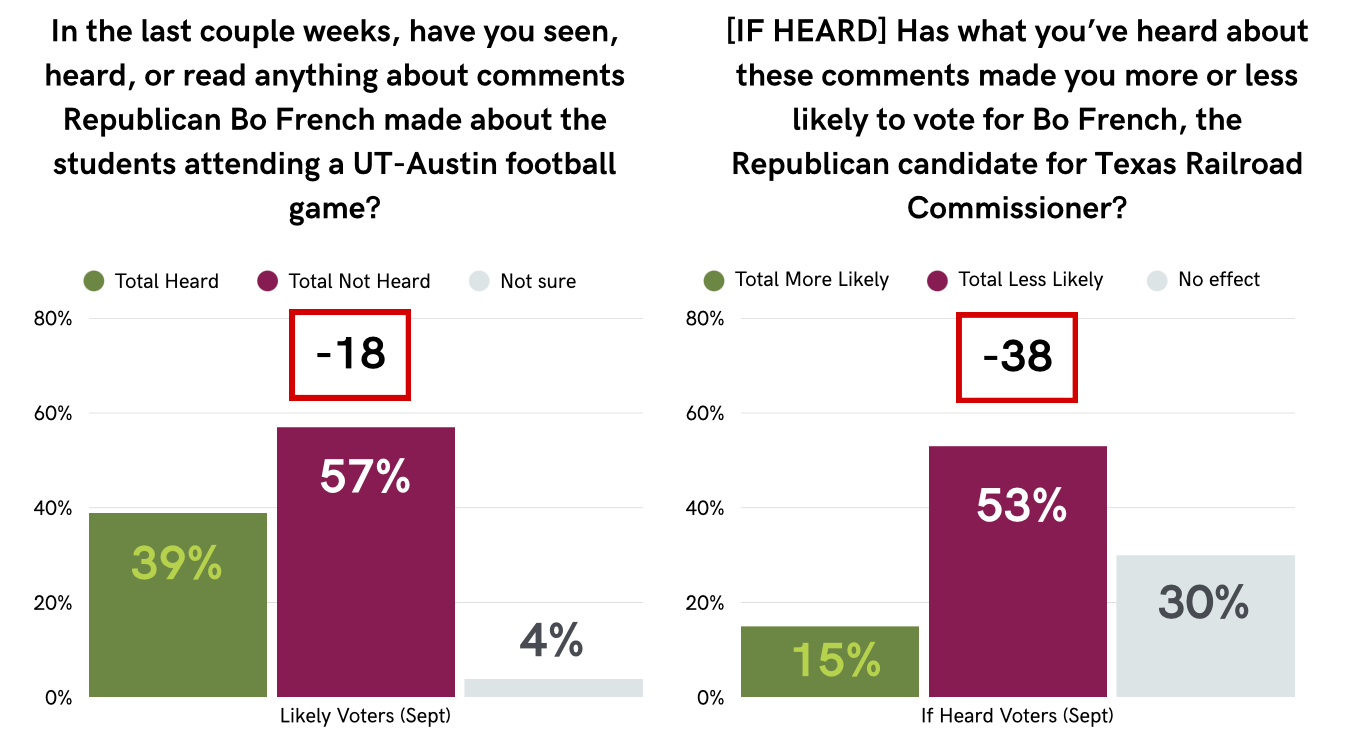
More than half of voters (57%) say they have not seen, heard, or read about French’s comments about students attending a UT-Austin football game, while 39% say they have. Among those aware of the comments, 53% say the comments make them less likely to vote for French and just 15% say they are more likely (net -38), while 30% say the comments have no effect on their vote.
Voter Sentiment
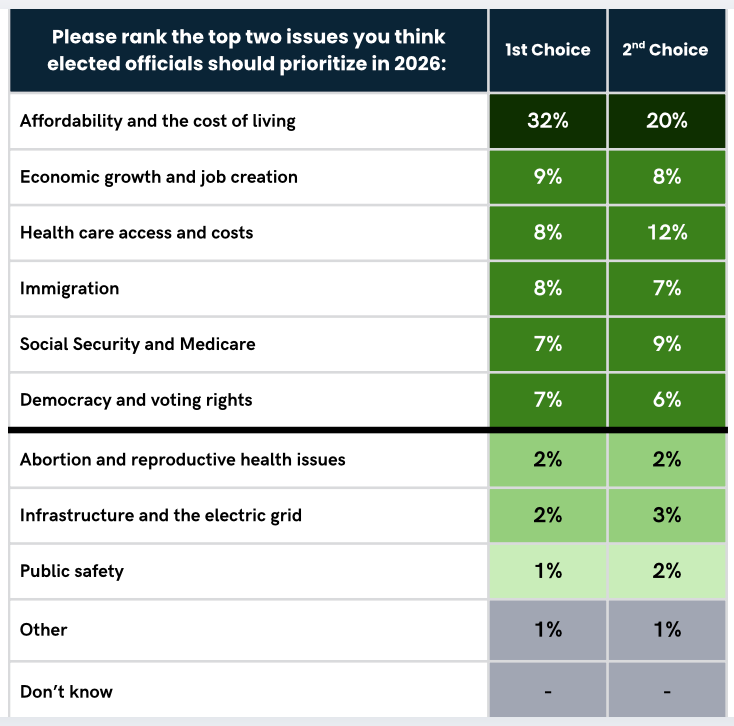
Affordability and cost of living is the most important issue for voters by a significant margin. When asked to rank the top two issues elected officials should prioritize in 2026, 32% choose affordability and cost of living as their first choice. Economic growth and job creation ranks second (9%), while health care access and costs and immigration tie for third (8% each).
The cross-tab data that has me nervous is Paxton leading by 4 points with voters 55-64 and by 8 points with voters 65+. History has shown that older voters turn out more reliably.
The cross-tab data that makes me hopeful is that they're running even (46-46) with voters without a college degree. If that's true, Paxton is in serious trouble, because voters with a college degree more reliably turn out for midterms.